

making a workshop on wheels.
or, what helps me tackle small apartment projects without losing my sanity.

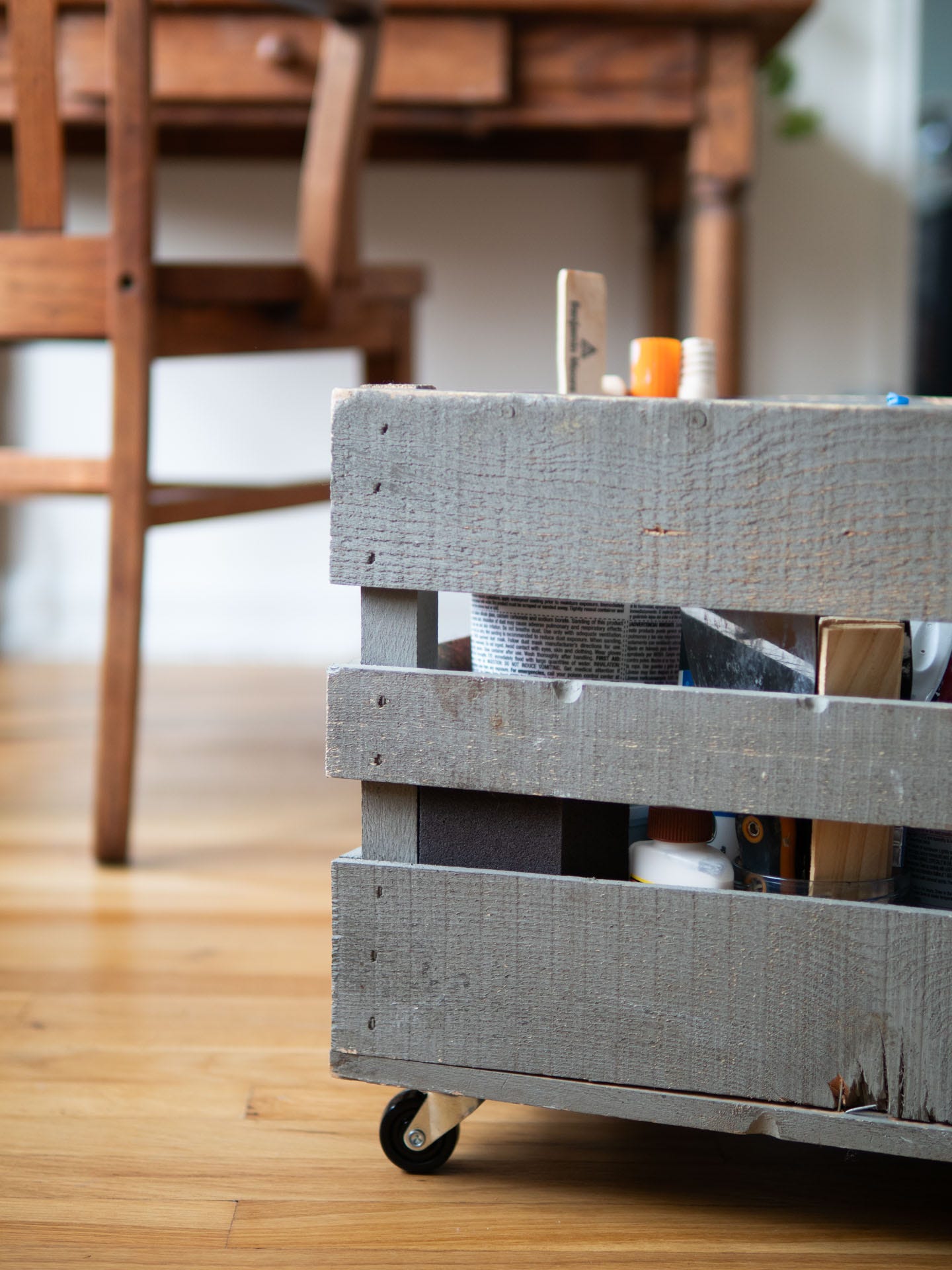
Being engaged in even fairly low-lift home improvements involves an accumulation of stuff that would make anyone with a disdain for clutter or a penchant for minimalism shudder. Everyone needs a proper tool box, I’ve said over and again, but it’s not only the tools an enthusiastic DIY’er needs, but also the materials and supplies those tools are destined to work with. Regrettably, not all these things fit in your average tool box.
At any given moment there might be need for paint and brushes and drop cloths, stir sticks, and paint keys to say nothing of paint thinner or stripper. There is likely caulk and wood filler and joint compound and putty knives of various sizes for applying the stuff. Where there is caulk and wood filler and joint compound there are sanding blocks and utility knives and razor blades. There might (woe is me) be four different boxes of wall anchors purchased in futile attempts to successfully mount a pair of peg rails to a terribly bowed wall. Depending on the level of intensity you’re playing at, there could very well be highly specific and very useful tools you never once dreamed of owning—grout removers and a grout float and a three-in-one caulk remover—but then here you are.
For people who live in places where space is abundant, these things might reasonably be kept in a place like a shed, or a garage, or a basement. One might go so far as to call this place a workshop. My dad’s workshop is a classic of the genre. It’s a spidery and dusty place nestled into the stone basement of an 18th century cobbler’s shop. His nails are neatly sorted into coffee cans and jars older than I am. A peg board on the stone wall has hooks for hammers and screw drivers, wrenches and putty knives. There are shelves of half-full paint cans, cans of mineral spirits from the 90s, and paint brushes of every size and shape. There’s a corner with lengths of scrap wood and saw horses, there’s a table saw and a paint-splattered radio from, I’m guessing, 1976. Always, but always, there’s a window pane he’s in the process of reglazing.
For folks who live in small urban apartments, a workshop is about as common as a walk-in pantry, which is to say, dream on. One might say that a particular advantage of renting an apartment as opposed to owning one is that keeping a lot of tools and supplies for maintenance falls under the purview of the super or the landlord. One might also not be familiar with how thoroughly some landlords are capable of not maintaining their property.